Jobs
TL;DR
- Imports, re-processing, embedding, collection and pushes run as jobs;
GET /jobs/{id}polls one. - Every job names the person who queued it in
created_by, andorigintells the instance's own work (auto) from requests (manual). - A failed job has
errorfor people anderror_codefor scripts. POST /jobs/{id}/cancelstops a job at its next step boundary and keeps what it finished.- An import lists its per-file problems as
{path, code, reason, is_skip}: branch oncode.
Endpoints
| Method | Path | Purpose | Caller or role |
|---|---|---|---|
GET |
/jobs |
list jobs | readable libraries |
GET |
/jobs/latest |
the newest job of every library version | readable libraries |
GET |
/jobs/{id} |
one job | viewer |
POST |
/jobs/{id}/cancel |
cancel a job | contributor |
GET |
/libraries/{owner}/{repo}/jobs |
one library's jobs, newest first | viewer |
GET |
/stats/jobs |
jobs per day by state and kind | operator |
A job
GET /jobs/{id} is one job:
| Field | Values |
|---|---|
| kind | import, refresh, reprocess, rechunk, retag, collect, embed or push |
| state | queued, running, succeeded, failed or cancelled |
done / total |
files, or chunks for embed |
chunked / reused |
chunk sets cut, articles whose chunk set was stored before |
parsed / taken |
articles parsed, articles taken from the catalog |
| problems | per file, see Job problems |
cancelled_by / cancelled_at |
who cancelled it, and when |
cancellable |
whether the caller may cancel it now |
Who queued a job
Every job (also on GET /jobs, a library's jobs and /jobs/latest) has created_by, the person
whose request queued it, as {"id": <account ID>, "username": ...}.
- It is the account of the session or API token (REST) or OAuth/API token (MCP), never the token or its ID.
- The user name is the one the account had then, so a job keeps naming its person after the account is removed.
- It is
nullwhen no person queued the job:- the instance's own work
- the command line on the server (
exactdocs ...without the API) - every job queued before ExactDocs recorded it. Upgrading leaves those
null; nothing can tell who queued them.
Origin
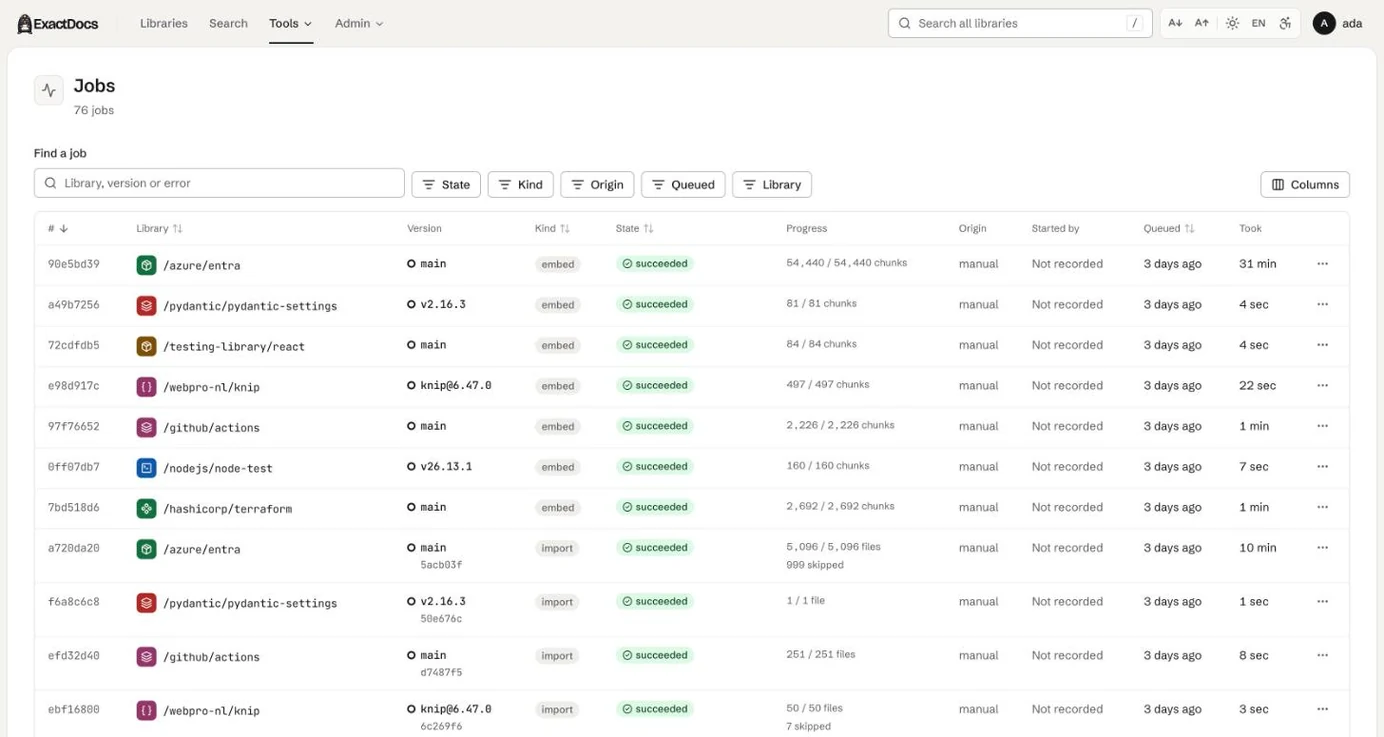
origin is stored with the job. It is manual unless the instance queued the job on its own,
which makes it auto:
- the scheduled check's tag imports and branch syncs, with the failures and recoveries they record
- a repository webhook's
pushjob and the sync or imports it queues - the
embedjobs the instance queues after an import, at start and nightly
An auto job never names a person. Jobs queued before this release keep the origin they were
stored with (a scheduled branch sync was manual then). Filter with origin=auto or
origin=manual on GET /jobs and GET /libraries/{owner}/{repo}/jobs.
Failures
A failed job has its error (for people), its error_code (stable, for scripts) and its
finished_at.
- The code of an upstream problem is one of
repo_unreachable,auth_failed,ref_deletedandtag_moved, the same for a sync and for an import that meets it. - Any other failure keeps the error's own code (
no_articles,commit_unavailable, ...) or isunexpected. - Jobs that failed before codes were recorded have
error_code: null.
embed jobs
An embed job embeds one version with the instance's embedding model.
- Its
totalcounts the version's chunks without a vector, each once. Identical files share their chunks, so they are embedded once. - Chunks another job embedded while it ran (files shared with another library) count in
doneand inreused, so a succeededembedjob ends withdone=total.
error_code |
Meaning | Queued again |
|---|---|---|
embedding_failed |
its error names the model and the HTTP status, never a key | at the next start |
ai_budget_reached |
a budget its embedding counts to (embedding, instance or library) was used up before its next batch |
just after the UTC midnight that resets the window |
The newest jobs
GET /jobs/latest is the newest job of every library version in one call ({"jobs": [...]}),
with skipped instead of the problem list.
- A
pushjob never counts; its outcome shows through the sync it queued. - The library list uses it to show freshness and sync errors without a request per library.
GET /libraries/{owner}/{repo}/jobs pages one library's jobs, newest first.
Job statistics
GET /stats/jobs?bucket=day&from=2026-11-01&to=2026-11-30 counts the jobs queued on each UTC day
from from to to by the state they are in now (by_state) and by kind (by_kind), with each
day's total.
| Parameter | Meaning |
|---|---|
bucket |
day, the default and only bucket |
from |
YYYY-MM-DD, included; default 29 days before to |
to |
YYYY-MM-DD, included; default today (UTC) |
- Every day of the range is listed, oldest first, and every state and kind with it, 0 included, so a chart needs no filling in.
- A range that ends before it starts, or covers more than 366 days, is a 422
invalid_range. - Operators only: a session or an API token of an
admin, 403forbiddenotherwise. The counts cover every library. - One grouped query on an index of the jobs' creation time.
Cancelling a job
POST /jobs/{id}/cancel needs the contributor role on the job's library. Operators always may;
anyone else gets 403 forbidden. CLI: exactdocs jobs cancel <id>.
| State | Effect |
|---|---|
queued |
becomes cancelled at once and never starts: its version stays as it was,or is never created for a first import |
running |
answers running with cancelled_at set, stops at its next step boundary,then ends cancelled with what it finished kept |
| ended | 409 job_finished with its job_state |
What a running job keeps:
- an import publishes nothing: its version is replaced in one step or not at all
- a
reprocess,rechunkorretagkeeps the versions it had finished - an
embedjob sends no batch after the one in flight and keeps the vectors stored (their spend is counted as usual)
Asking again while it stops answers the same job.
After a restart
- The cancellation is stored, so it survives a restart: a job interrupted while it was stopping
ends
cancelledon the next start. - The scheduled check does not queue a cancelled auto import or branch sync again at the same commit. A new commit, or a sync or import by hand, does.
- The start and the nightly upkeep leave a version whose embedding was cancelled alone. An import of the version, or a change of the embedding model, queues it again, and it resumes from the chunks still missing vectors.
Job problems
GET /api/v1/jobs/{id} lists the problems an import found per file as
{path, code, reason, is_skip}.
reasonis a sentence for people and may change; branch oncode.is_skipis true when the file was left out of the version, false when it was imported anyway.skippedonGET /api/v1/jobs/latestis the number of skipped files, exact even when the list is capped.
code |
is_skip |
Meaning |
|---|---|---|
binary |
true | the file contains NUL bytes |
too_large |
true | the file is over the per-file size cap (2 MiB by default) |
undecodable |
true | the file is not text in UTF-8, UTF-16/32 with a BOM or Windows-1252 |
not_a_file |
true | not a regular file (for example a symlink) |
unreadable |
true | the file could not be read |
bad_file_name |
true | the file name is not valid UTF-8 |
unparsable |
true | the file was read but could not be parsed or cut into chunks; the rest of the version is imported |
front_matter |
false | the article was imported, its front matter is malformed or partly ignored |
truncated |
false | marker with an empty path: more files were skipped than are listed |
- Text is decoded as UTF-8, then UTF-16/32 announced by a byte order mark, then Windows-1252 (which covers Latin-1 files).
- At most 1000 skips and 200
front_matternotes are listed.
New codes may be added
Clients must treat an unknown code as a generic problem, using is_skip to tell skips from
notes.