AI providers and model roles
TL;DR
- Model endpoints are provider profiles, used by roles as
<profile>:<model>; they need theexactdocs[ai]extra. - There are four roles:
embedding,reranker,llmandjudge. - Profiles never read
OPENAI_API_KEYand similar variables, and extra headers carry no credentials. - Profiles from the environment or the file are read-only over REST.
Model endpoints are provider profiles. Each is named once, and every role uses it as
<profile>:<model>. Configure them in the environment or in the TOML file that
EXACTDOCS_CONFIG_FILE names; the environment wins, field by field. They need the exactdocs[ai]
extra (uvx --from 'exactdocs[ai]' exactdocs serve, or an -ai image). While no profile is
configured, none of this is imported and nothing is sent anywhere.
# EXACTDOCS_CONFIG_FILE=/etc/exactdocs/exactdocs.toml
[ai.providers.corp]                     # a company gateway speaking the OpenAI API
kind = "openai-compatible"
base_url = "https://llm.example.com/v1"
api_key_file = "/run/secrets/corp_llm_key"   # never api_key in the file
headers = { "X-Team" = "docs" }     # no credentials here: Authorization, *-key, *-token are refused
proxy = "http://proxy.example.com:3128"
request_timeout = 30

[ai.llm]
model = "corp:gpt-4.1-mini"

[ai.embedding]
model = "corp:text-embedding-3-small"   # instance-wide only
dimensions = 1024                       # optional: ask the model for shorter vectors
batch_size = 64                         # chunks per call and per durable step
The same in the environment: EXACTDOCS_AI__PROVIDERS__CORP__KIND=openai-compatible,
EXACTDOCS_AI__PROVIDERS__CORP__API_KEY=..., EXACTDOCS_AI__LLM__MODEL=corp:gpt-4.1-mini.
There are four roles: embedding, reranker, llm and judge. The judge defaults to the llm.
A profile's proxy carries its calls (and its Entra ID sign-in) and wins over everything else. A
profile without one connects directly, whatever HTTPS_PROXY says, unless
EXACTDOCS_AI__USE_INSTANCE_PROXY=true: then it goes through the instance's outbound proxy
unless NO_PROXY lists its endpoint. The instance's CA bundle (EXACTDOCS_CA_BUNDLE, or
SSL_CERT_FILE) is trusted by every profile. See
Behind a corporate proxy.
Provider kinds
| Kind | Notes |
|---|---|
openai-compatible |
any gateway: a base URL and an optional key |
openai, openrouter |
|
anthropic |
platform = "api", "vertex", "foundry", or "bedrock" (needs boto3, which the images do not include) |
azure |
Azure OpenAI: base_url or resource, api_version, and a key or auth = "entra" |
google-vertex |
project, location and credentials_file, or credentials = "adc", or an Express-mode key |
google |
the Gemini API |
ollama, vllm, litellm |
self-hosted servers |
deepseek, together, fireworks, cerebras, github, vercel, moonshotai, heroku, nebius, ovhcloud, sambanova, alibaba |
pydantic-ai's OpenAI-API providers |
tei |
Text Embeddings Inference serving a reranker; the reranker role only |
local |
models in this process; see Local models |
Groq, Mistral, Cohere, xAI and Bedrock are reached through their OpenAI-compatible endpoint or through LiteLLM.
How profiles handle credentials
Every SDK client gets its endpoint, key (unused for a profile without one), project, region and
API version from the profile, and nothing else. OPENAI_API_KEY, OPENAI_BASE_URL,
ANTHROPIC_API_KEY, AZURE_OPENAI_*, GOOGLE_* and similar variables are never read, and each
profile's HTTP client refuses any scheme, host or port but its own endpoint's.
OPENAI_CUSTOM_HEADERS and ANTHROPIC_CUSTOM_HEADERS are removed from the process before any SDK
client is built, because the SDKs would let them replace a profile's key.
Extra headers carry no credentials. Authorization, Cookie, x-api-key, api-key and names
ending in -key, -token, -secret or -password are refused with "use the key field", so no
credential sits unsealed in the database or the file.
The server's own cloud identity (credentials = "adc", credentials_file, auth = "entra", and
Claude on Bedrock, which signs with the AWS identity) is only used by profiles from the environment
or the TOML file, never by ones created over REST. Such a profile takes no base_url. Its endpoint
is derived from location or resource (Google's, Azure's or AWS's own), so the token never
reaches another host:
resource,locationandprojectmust each be a single DNS label (letters, digits, inner hyphens). GCP's legacy domain-scoped project IDs (example.com:project) are therefore refused.- A derived endpoint is built with a URL constructor and checked against the provider's exact host
form:
<resource>.openai.azure.com,<resource>.services.ai.azure.com,bedrock-runtime.<region>.amazonaws.com, or Vertex AI'saiplatformhosts. - An Entra ID credential chain (client secret or certificate, workload identity, managed identity,
user-assigned through
AZURE_CLIENT_ID) is built once per profile. The profile'sproxycarries the calls tologin.microsoftonline.com, but never those to managed identity's local endpoint. Entra ID never uses the Azure CLI, PowerShell, VS Code or any developer sign-in; for local development, use a client secret (AZURE_TENANT_ID,AZURE_CLIENT_ID,AZURE_CLIENT_SECRET). - Google's token refresh uses the standard proxy variables, because google-auth reads them itself; the server sets them from its outbound settings at start (Behind a corporate proxy).
Managing profiles
Over REST (/api/v1/ai/providers, admins only), profiles can be created, changed, deleted and
checked. Their keys are sealed with the secret key (EXACTDOCS_SECRET_KEY or secret.key, under a
key derivation of their own) and never returned. Profiles from the environment or the file are
read-only there. A stored key is dropped, not reused, when the profile's endpoint changes.
exactdocs ai check, run where the server runs, makes one minimal call per role and prints the
latency, the model that answered and an embedding's dimensions, never a key.
POST /api/v1/ai/providers/{name}/check does the same for one profile.
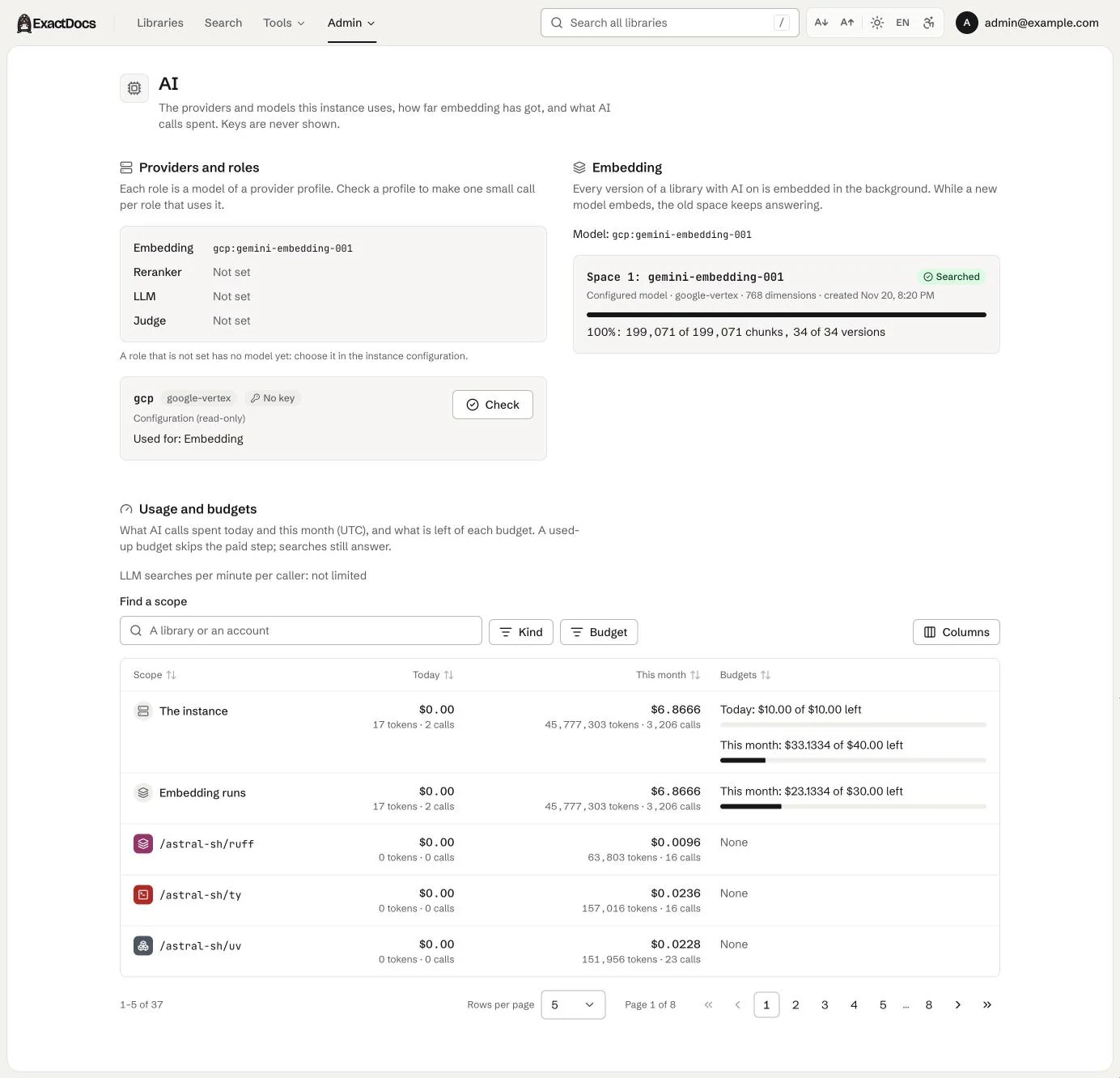
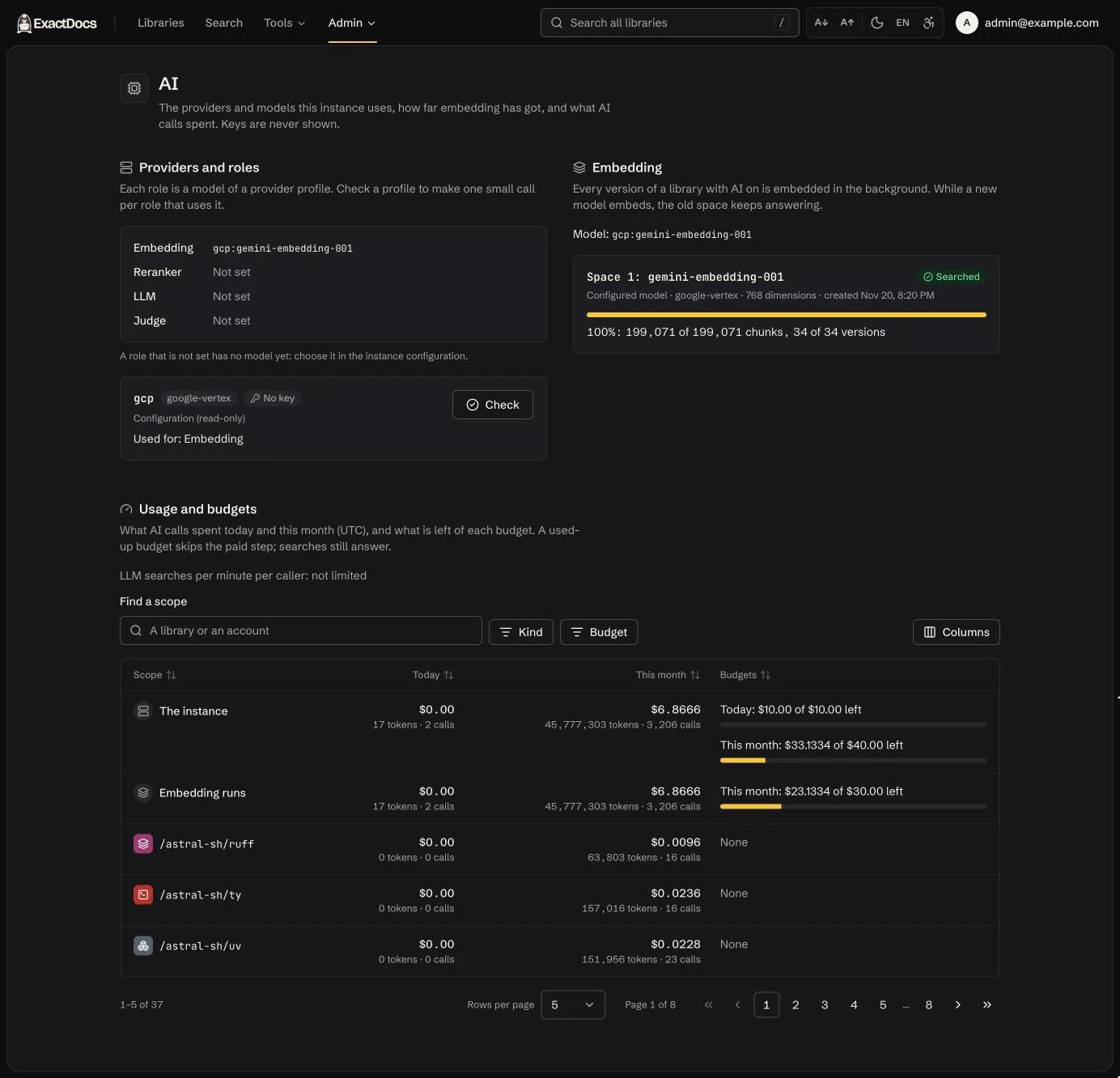
The AI page of the web UI (admins only) lists the providers and roles (never a key) with a check
per profile, the embedding progress of each space (GET /api/v1/ai/embedding), and the usage and
budgets described below.
Per-library settings
PUT /api/v1/libraries/{owner}/{repo}/retrieval sets, for one library:
- whether AI is on. When it is off, nothing of the library is ever sent to a provider and its searches are BM25;
- its own
llm,judgeandreranker, and its ownrerank_top_n; - its own thinking levels,
llm_thinkingandjudge_thinking(see Thinking level); - what reranks it:
rerank_with,cross_encoderorjudge; - its own spend limits per day and month (
budgets), no higher than the instance's; - its
repo_guidance(see Repo guidance).
The embedding model is instance-wide only. The library's settings page (Retrieval and AI) shows the pipeline its searches run now and edits all of these.