Libraries and versions
TL;DR
POST /librariesvalidates everything first, stores the library and queues animportjob; the library has no versions until that job has run.POST /repositories/refsand/repositories/previewlook at a repository before adding it, and nothing is stored.- A repository's root
context7.jsondecides the paths of a library added without paths, and itsrulescome first in everyquery-docsanswer. POST .../versionsadds a version with the library's own paths, tag rules and chunking.- Removal answers at once and a
collectjob frees what nothing else shares; it is refused while an import runs.
Endpoints
| Method | Path | Purpose | Caller or role |
|---|---|---|---|
GET |
/libraries |
list libraries | any caller1 |
POST |
/libraries |
add a library | any caller2 |
GET |
/libraries/{owner}/{repo} |
one library | viewer |
PATCH |
/libraries/{owner}/{repo} |
edit title and description | admin |
DELETE |
/libraries/{owner}/{repo} |
remove the library | creator |
GET |
/libraries/{owner}/{repo}/logo |
the library's logo | viewer |
GET |
/libraries/{owner}/{repo}/access |
whether a credential is stored | viewer |
PUT |
/libraries/{owner}/{repo}/default-version |
pin the default version | admin |
DELETE |
/libraries/{owner}/{repo}/default-version |
unpin it | admin |
GET |
/libraries/{owner}/{repo}/versions |
list versions | viewer |
POST |
/libraries/{owner}/{repo}/versions |
add a version | contributor2 |
DELETE |
/libraries/{owner}/{repo}/versions/{ref} |
remove a version | admin |
POST |
/repositories/check |
check a repository | any caller2 |
GET |
/repositories/refs?url= |
a repository's branches and tags | any caller |
POST |
/repositories/refs |
the same, with a credential | any caller2 |
POST |
/repositories/preview |
dry run of an import | any caller2 |
Paths, tag rules and chunking are on Library settings, retrieval settings on Search and answers, and syncing on Syncing.
Adding a library
POST /libraries with {"url", "library_id"?, "ref"?, "include_paths"?, "exclude_paths"?}
validates everything first, then stores the library with its selection and queues an import
job.
It answers 201 with:
library_idref, andref_kind(tag,branchorcommit)commit_shajob_id- a
Locationheader with the library
ref is one of:
- a tag; a tag wins over a branch of the same name
- a branch
- a full or short (7+ characters) commit SHA that is the tip of a branch or tag
- omitted: the default branch
| Error | When |
|---|---|
422 unknown_ref |
a ref that is not found |
422 ambiguous_ref |
a short SHA that starts two commits |
422 invalid_path_pattern |
a bad pattern |
409 library_id_taken |
a taken ID (Errors) |
The library has no versions until its import has run; the job records the pinned ref and commit.
Path patterns
Patterns are repo-relative and case-sensitive, never absolute or with ...
| Pattern | Means |
|---|---|
docs/ |
a folder |
docs/**, *.md, ?, {a,b} |
globs |
no *, ? or { |
a path: a file, or a folder and everything below it, with or without a trailing / |
[ |
a plain character (no character classes), so app/[locale] is a folder |
- No
include_pathsmeans every.md/.mdxfile. Only those are ever articles. - An exclusion always wins.
Looking at a repository first
Lists default_branch, branches and tags (name and commit_sha, sorted), 1000 of each at
most, with truncated set when more exist.
Body url, optional credential. Gives the same answer for a private repository. The
credential travels in the body, never in a URL, and is not stored.
Body url, optional ref, include_paths, exclude_paths, credential. A dry run:
- It fetches the commit and its trees only (
--filter=blob:none, depth 1, no checkout). Git's process limits, and the fetch deadline and size watchdog, apply. - It also fetches the root
context7.jsonalone (see below: a second blob-less fetch under a preview slot). - It answers
ref,ref_kind,commit_sha,files(sorted, 1000 at most),total,truncated,include_paths,exclude_paths,context7andcontext7_warning. - The same selection rules as the import decide, so nothing is stored.
- Sizes are not included: they would need the blobs.
Errors are those of adding a library, plus 422 commit_unavailable, and 422
repository_too_large when the fetch or the tree listing is too large.
It does a real fetch of the commit's trees, so it is slower than /repositories/check. At
most two run at once, and a third waits a few seconds, then gets 429 preview_busy with a
Retry-After header (seconds).
Warning
- Paths are untrusted text; render them as text.
- Like
/repositories/check, all of them acceptfile://, localhost and private addresses (see SECURITY.md).
Private repositories
A credential, {"kind": "token", ...} or {"kind": "ssh_key", ...}, is accepted by:
POST /repositories/checkPOST /repositories/refsPOST /repositories/previewPOST /librariesPOST /libraries/{owner}/{repo}/versions
Only on a signed-in session: an API token gets 401.
- It is stored encrypted for that library and its host, and never returned.
- A deploy key keeps its line breaks (
\nin JSON). One sent on a single line, or with a passphrase, is 422invalid_credentialwith a sentence saying so. GET /libraries/{owner}/{repo}/accessanswers{"private": true | false}: whether the library has a stored credential.
context7.json
A repository's root context7.json (LIB-06) is read when a library is added or previewed, and
again by every import.
Reading it
- For an add or a preview, only that one file of the pinned commit is read: its tree entry, then its blob.
- Reading it for an add or a preview uses a preview slot, never an import's, and waits for one only as long as a preview does.
- When every slot stays busy:
- an add sent without paths answers 429
preview_busy(withRetry-After) before anything is stored, because the file would decide the library's paths for good - a preview, or an add with paths, goes on with a warning instead
- an add sent without paths answers 429
Keys
Used keys: projectTitle, description, folders, excludeFolders, excludeFiles, rules,
previousVersions. Others ($schema, url, ...) are ignored.
Paths
Sent without include_paths and exclude_paths, POST /libraries and
POST /repositories/preview apply its folders and exclusions:
- A folder is that path and all below it.
.is the whole repository; a leading./or/means the root. - An excluded folder or file given by its bare name (
archive,CHANGELOG.md) is excluded wherever it is; one with a/(./docs/internal) only at that path. - Globs are taken as patterns.
Paths a user sends win. To import every article and ignore the file's paths, send
"include_paths": ["**"]. The library keeps the paths it was created with for every later
version, until they are edited with PUT /libraries/{owner}/{repo}/settings.
Title, description and rules
- The default version's
projectTitleanddescriptionwin over its README; a user's edit wins over both. - Its
rules(at most 20 distinct ones of at most 500 characters) are stored on the library (rulesinGET /libraries/{owner}/{repo}).- They come first in every
query-docsanswer, under a heading that marks them as untrusted repository text. - They take at most a quarter of the size budget: whole rules, from the first one on, until one does not fit.
- They are the default version's rules:
query-docsfor/owner/repo/<ref>shows them too, not that version's.
- They come first in every
In the responses
Both responses carry:
include_pathsandexclude_paths(what is applied)context7: the parsed file, with its paths translated, itsrules,previous_versions(tag,title) to offer for import withPOST /libraries/{owner}/{repo}/versions, andnotescontext7_warning
Problems with the file:
- A
previousVersionsentry whose tag git would not accept as a ref name (--upload-pack=x,a..b) is left out and named innotes. The rest of the file still applies. - A file that is not a JSON object of the right types, larger than 64 KiB, or that cannot be read
is ignored:
context7is null andcontext7_warningsays why. - An import lists both kinds as
context7problems of its job (the import goes on).
Warning
All of it is untrusted repository text.
Editing a library
PATCH /libraries/{owner}/{repo} with {"title"?, "description"?}. An edited field is kept
across re-imports instead of following the default version's context7.json or root README
(LIB-07).
Pinning the default version
PUT /libraries/{owner}/{repo}/default-version with {"ref"} makes that version what
/owner/repo without a ref means, even after a higher stable tag is imported (LIB-10). The ref is
an imported ref exactly as listed, or a unique short SHA of a commit version.
DELETEon the same path unpins it, and the default follows the Default version rule again.- Both answer 200 with the library.
- Libraries carry
default_pinned(also in the MCPlist_librariestool). - Removing the pinned version unpins the library.
| Error | When |
|---|---|
404 not_found |
a ref the library has not imported (refs are case-sensitive), or an unknown library |
| 422 | a missing or empty ref, a malformed library ID or ref, or a short SHA that matches more than one commit version |
Note
Changing the pin does not re-derive the title, description and logo from the new default's README (LIB-07). Re-import the new default to refresh them.
Library logos
Libraries (#504) carry logo in GET /libraries, GET /libraries/{owner}/{repo} and every
answer that returns a library, MCP list_libraries too. It is the logo's version, 16 hex digits
of the SHA-256 of its bytes, or null when the importer found none.
GET /libraries/{owner}/{repo}/logo serves it from ExactDocs itself, never from the git host.
- Content: a PNG, JPEG or WebP as the repository has it, or an SVG as the importer cleaned it, with the stored type.
ETagis the version;If-None-Matchanswers 304.- Asset headers:
X-Content-Type-Options: nosniffCross-Origin-Resource-Policy: same-originContent-Security-Policy: default-src 'none'; style-src 'unsafe-inline'; sandbox; ...
- An SVG is an attachment, which an
<img>still shows.
| Request | Cache-Control |
|---|---|
?v= set to the current version |
private, max-age=31536000, immutable (the URL changes with the logo) |
| otherwise | private, no-cache |
An old v gets the current logo, never a cached old one. A library without a logo (or unknown,
or hidden from the caller) is 404 not_found.
The logo is the default version's:
- Each import or re-sync of the version that is then the default looks for one and replaces the library's, or removes it when the version has none.
- Importing any other version changes nothing.
- A library imported before logos existed gets one at the next import of its default version
(
versions/reimport, a re-sync of a branch that moved, or a paths edit).
Where the importer looks and what it keeps: Architecture, Project logos.
Sizes on the lists
Sizes (#513) come with the lists:
| List | Field | Counts |
|---|---|---|
GET /libraries/{owner}/{repo}/versions |
articles |
entries of the version's active manifest, what list_articles lists |
chunks |
the chunks they are cut into for search, one per article path that holds it |
|
embedded_chunks |
of those, the ones with a vector from the configured embedding model, in its current space |
|
GET /libraries (and MCP list_libraries) |
article_count |
the articles of its default version, the one /owner/repo resolves to |
A count is 0, never null, when there is nothing to count:
- a library without a version
- a version not indexed
embedded_chunkswhile no embedding model or vector store is configured, or while the configured model has no space yet or no vector of the version (a library with AI off is never sent to it)
The counts are read once per page whatever its size (a grouped query per domain, no request or query per version), so the versions table and the overview need one request.
Libraries by sync state
GET /libraries?sync_state=failed (repeatable, any job state) lists the libraries whose latest
sync, their newest import or refresh job, is in one of those states.
- A library that never synced matches none.
- A newer job of another kind (
embed,collect, ...) does not change it. - The catalog still filters, sorts and pages, so the filter works with every other filter,
cursorandoffset, andtotalcounts the matches. - The instance reads every library's latest sync in one grouped query.
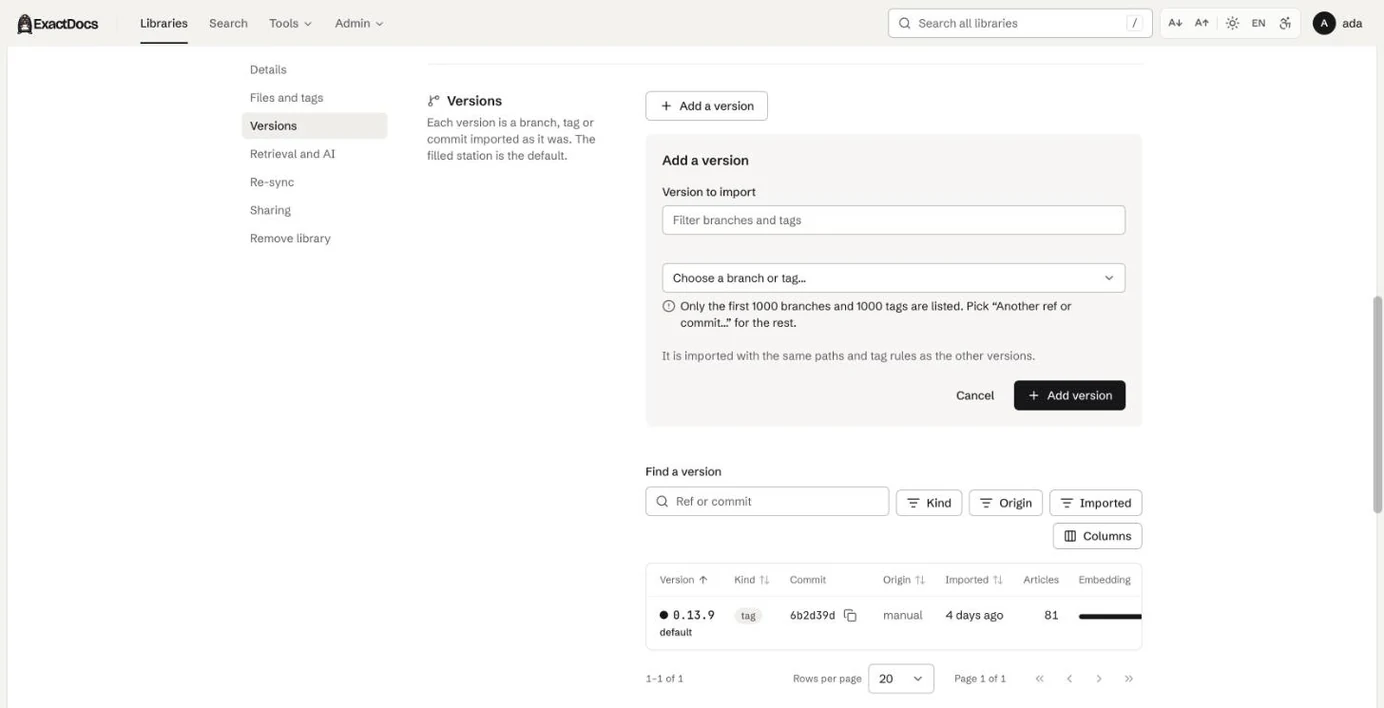
Adding a version
POST /libraries/{owner}/{repo}/versions with {"ref"} imports another version of an existing
library with the library's own include/exclude paths and tag rules (and chunking), so versions
stay comparable.
- The ref is resolved like when adding a library (tag over branch, full or short SHA).
- It answers 202 Accepted with the same body as adding a library (
library_idis the existing library) andLocation: /api/v1/jobs/{job_id}, the import job to poll. The version exists once its import has run. - The default version is computed from the versions, so it moves when the import finishes:
- a newer stable tag takes it
- a branch does not take it from a release
- a pinned default does not move
| Error | When |
|---|---|
404 not_found |
unknown library |
422 unknown_ref / ambiguous_ref |
as when adding a library; also 422 for a malformed library ID |
409 version_exists |
the library already has that ref; re-importing is a sync, not this call |
409 version_importing |
an import of that ref is queued or running3 |
409 commit_already_imported |
a commit SHA that is already a version under another ref, named in the message |
A tag and a branch at the same commit stay two versions.
Removing
DELETE /libraries/{owner}/{repo}/versions/{ref} and DELETE /libraries/{owner}/{repo} answer
200 with:
| Field | Meaning |
|---|---|
library |
the library |
ref |
null for a library |
default_version |
what /owner/repo means now; null when no version is left |
collection_job_id |
null if it could not be queued |
- The version or library is gone from browse, search and
list_libraries(REST and MCP) when the call returns. - A
collectjob (see/jobs/{id}) then frees the article texts and chunk sets no remaining version or library shares. - A collection that is still queued for the library is reused.
- Removing the last version keeps the library, without versions.
Removal and imports
- An unknown library or version is 404.
- While an import of that version (of any version, for a library) is queued or running, the call
is refused with 409
import_in_progress. - Removal never cancels a job. Cancel it first:
POST /jobs/{id}/cancel. - The removed version's (or library's) job history is deleted, so
/jobs/latestshows no state for it. - A re-sync of an existing version (E9-01) must be queued as a
refreshjob. It fails with 404not_foundat store time if the version was removed meanwhile, so a removal is never undone by a late sync. A first import is animportjob.
Known limits
- Chunk IDs of a removed version answer
not_found. They are not kept as tombstones yet (E9-03 follow-up, the strict xfail intest_chunk_store.py). - A library title derived from the default version's README (#33) is not re-derived by a removal.
-
It lists only libraries the caller holds a role on. See Library roles. ↩
-
A
credentialneeds a signed-in session. See Private repositories. ↩↩↩↩↩ -
Enforced atomically, so two simultaneous requests queue one import. ↩